
Papeda dengan Ikan Kuah Kuning
Sticky sago porridge eaten alongside fish in a bright yellow turmeric broth. The defining staple of Papua and Maluku, unlike rice anywhere else.
- prep
- 20 min
- cook
- 25 min
- total
- 45 min
- serves
- 4
- level
- medium
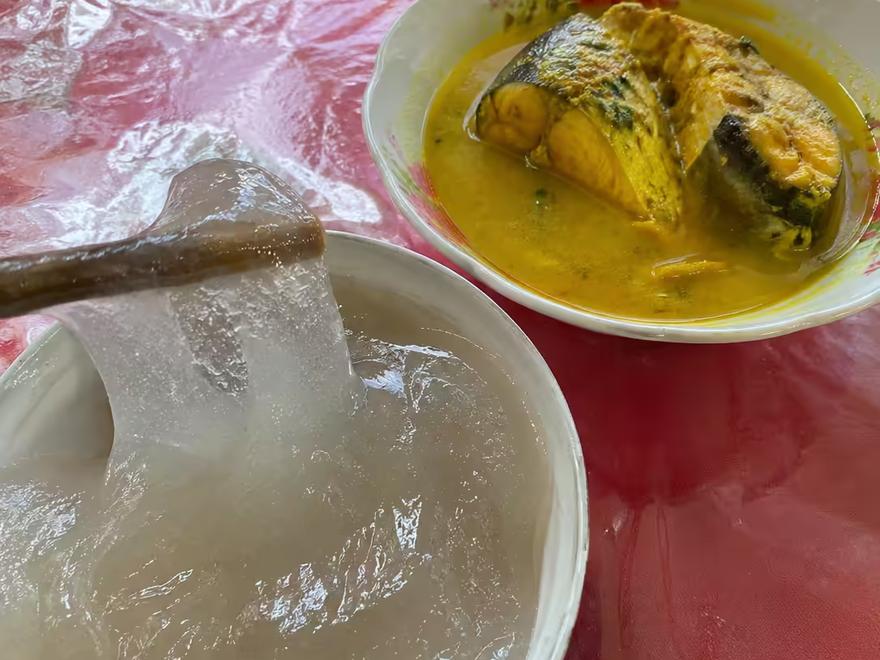
In Papua and Maluku, sago, not rice, is the everyday starch, and papeda is how it is eaten: boiling water stirred hard into sago starch until it turns, in under a minute, into a thick, sticky, almost glue-like gel.
It is eaten with a twirl, lifted on a fork in one motion rather than scooped, alongside ikan kuah kuning, a bright turmeric fish broth. The broth is what carries the flavor; the papeda itself is deliberately plain.
Part of our 20 best Indonesian recipes list.
method
Mix the sago starch with 300 ml of the water until smooth, forming a thin, cloudy liquid.
Bring the remaining 600 ml water to a rolling boil. Pour it all at once into the sago mixture while stirring vigorously and constantly with a fork or whisk.
Keep stirring as the mixture rapidly turns from cloudy white to a thick, translucent, sticky gel. This happens within a minute or two; do not stop stirring during this change.
Cover the papeda and keep it warm; it is served warm, not hot, and holds its texture for a while.
For the fish, blend the shallots, garlic, turmeric and ginger into a paste. Fry it in the oil for 3 to 4 minutes, until fragrant.
Add enough water to make a light broth, along with the lemongrass and whole chilies. Bring to a simmer.
Add the fish and simmer gently for 8 to 10 minutes, until just cooked through. Stir in the lime juice and season with salt.
Serve the papeda alongside the fish and its yellow broth, ladling some broth over the papeda itself.
chef's tips
- Traditionally papeda is eaten by twirling it onto a pair of special forks or chopsticks, lifting a portion in one continuous motion rather than scooping it like regular rice.
- The transformation from cloudy liquid to sticky gel happens fast, so have your pot and fork ready before you pour in the boiling water.
- Sago starch is a specialty ingredient outside Indonesia, found at some Southeast Asian grocers. Tapioca starch is not a true substitute; the texture is genuinely different.
- The broth is meant to be bright and tangy rather than rich, so go easy on the oil and let the turmeric, ginger and lime lead.