
Spandauer
A flaky, laminated Danish pastry with a central custard or jam filling, finished with icing - the classic Danish pastry shape.
- prep
- 1 h 30 min
- cook
- 20 min
- total
- 1 h 50 min
- serves
- 8
- level
- hard
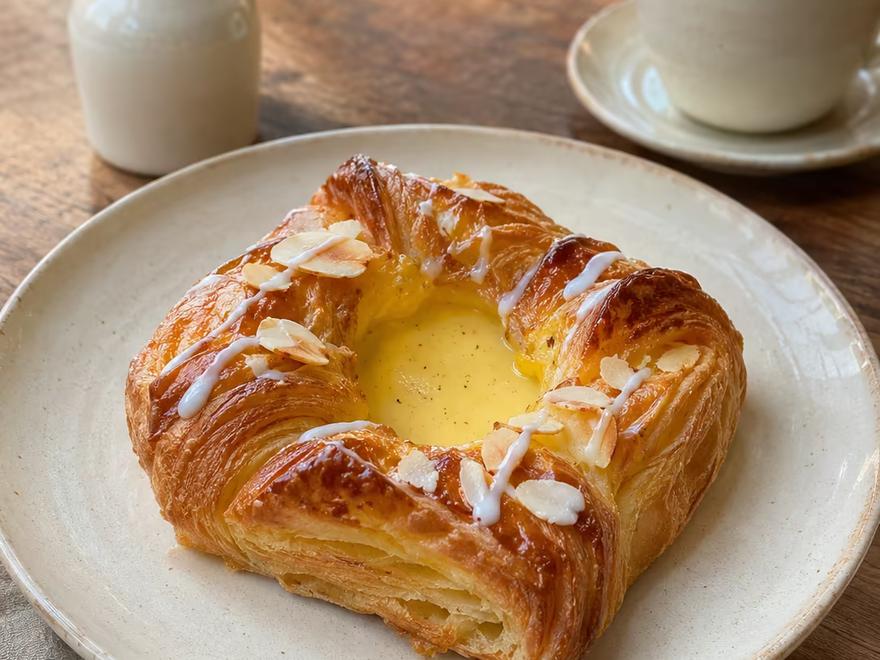
Spandauer is what most people picture when they hear 'Danish pastry': a laminated, buttery dough folded around a pool of custard or jam, the corners pressed in to hold it.
Lamination is the real technique here - keeping the butter cold through several rounds of rolling and folding is what builds the distinct, flaky layers rather than one dense, greasy dough.
Part of our 20 best Danish recipes list.
method
Make the custard first so it has time to cool: whisk the egg yolks, sugar and cornstarch together, pour over scalded milk whisking constantly, then return to the heat and cook until thick. Stir in vanilla and chill with cling film pressed onto the surface.
Mix the flour, sugar, yeast, salt, milk and egg into a smooth dough and chill for 30 minutes.
Roll the butter block between parchment into a flat square and chill.
Roll the dough into a larger square, place the butter block in the centre, and fold the dough over it to enclose completely.
Roll out into a long rectangle and fold into thirds, like a letter; chill 30 minutes. Repeat this roll-and-fold two more times, chilling between each.
Roll the laminated dough out to about 5mm thick and cut into squares, about 10cm across.
Fold the four corners of each square into the centre, pressing down firmly, and place a spoonful of cold custard in the middle.
Prove the shaped pastries for 30-40 minutes until puffy, then bake at 200°C (390°F) for 15-18 minutes until deeply golden.
Drizzle with icing once cooled slightly.
chef's tips
- Keep the butter cold but pliable throughout lamination - if it gets too soft it squeezes out the sides instead of staying in distinct layers, and that's what gives spandauer its flake.
- Chill the dough between every fold, not just at the start - skipping a rest is the single biggest cause of torn or merged layers.