
Soparnik
A thin savory pie from Poljica, filled with Swiss chard and onion, baked flat and brushed with olive oil and garlic.
- prep
- 40 min
- cook
- 20 min
- total
- 1 h
- serves
- 8
- level
- medium
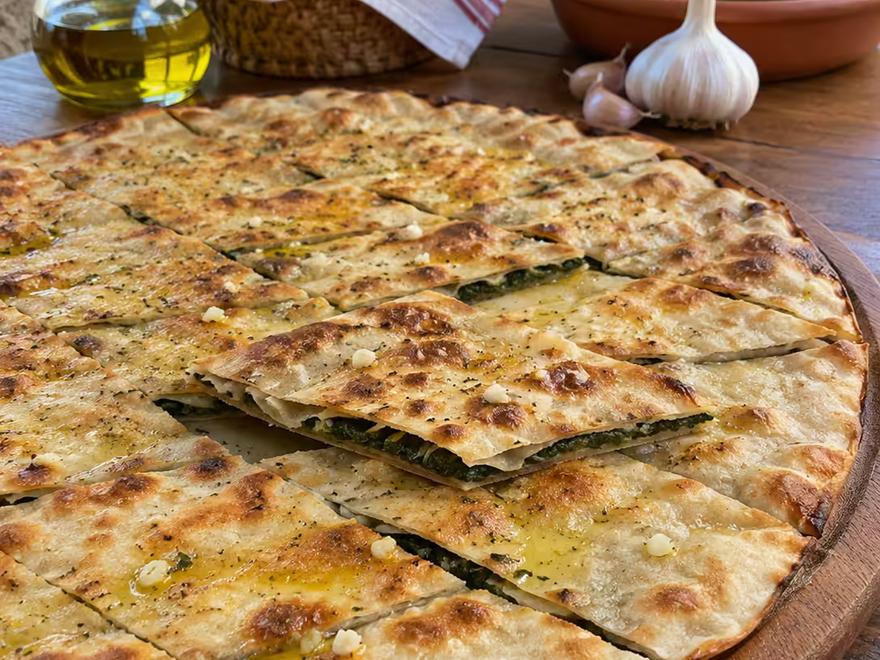
Soparnik comes from Poljica, a small region behind Split with its own old legal tradition, and the pie is just as singular: a thin savory pie of Swiss chard and onion, baked flat between two sheets of dough.
Locals still bake it directly on a hot hearth stone at village festivals, finishing it with a brush of garlic and olive oil the moment it comes off the heat.
Part of our 20 best Croatian recipes list.
method
Make the dough: mix the flour, water, 3 tbsp olive oil and salt into a smooth, elastic dough. Knead for 10 minutes, then rest covered for 30 minutes.
Massage the chopped chard lightly with a little salt, the chopped onion and 2 minced garlic cloves, to soften it slightly. Drain any excess liquid.
Divide the dough into two pieces. Roll each out very thin into a large round or rectangle, roughly the same size.
Lay one sheet on a lightly oiled baking tray. Spread the chard filling evenly over it, leaving a small border.
Lay the second dough sheet over the top, press the edges to seal, and prick the top all over with a fork.
Bake at 230°C (450°F) for 15 to 20 minutes, until the top is golden and crisp in spots.
While still hot, mix the remaining garlic into a little warm olive oil and brush it generously over the top.
Cut into diamond-shaped pieces and serve warm or at room temperature.
chef's tips
- Soparnik has protected traditional status and a dedicated festival in the Poljica region, where it is traditionally baked directly on the hot hearth stone, not in a tray.
- Massaging the chard with salt before baking draws out some water, which keeps the pie from turning soggy once it bakes.
- Brush the garlic oil on while the pie is still hot. It soaks in better, and the smell alone is worth the timing.
- This is traditionally cut into diamond shapes, not squares, before serving.