
Man’oushe Za’atar
Lebanese man'oushe za'atar: soft, blistered flatbread brushed with olive oil and a thyme, sesame and sumac mix. A simple yeast dough, baked in a very hot home oven in under 10 minutes.
- prep
- 1 h 40 min
- cook
- 20 min
- total
- 2 h
- serves
- 4
- level
- easy
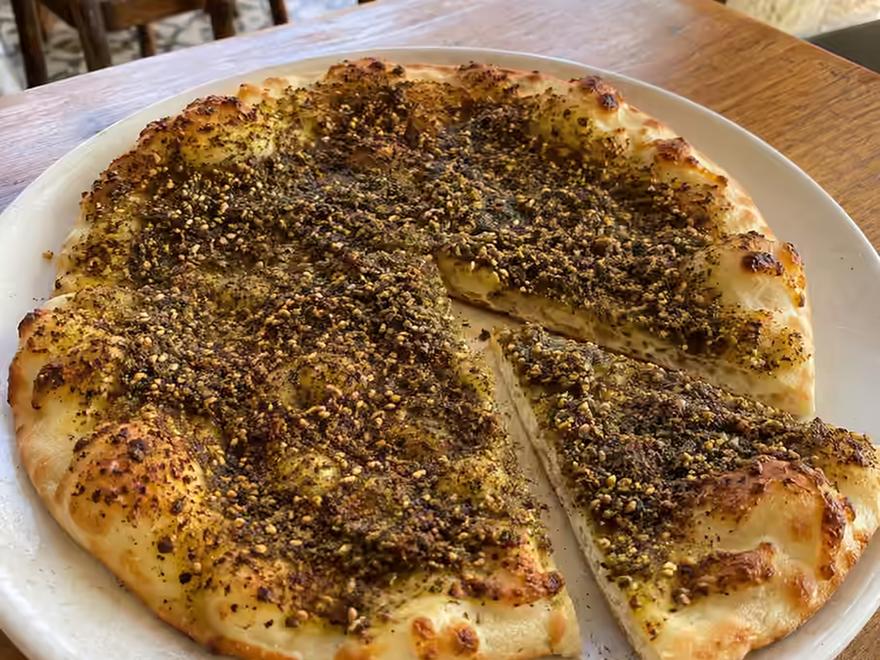
Man'oushe is the flatbread Lebanese families buy hot from the neighborhood bakery for breakfast. The za'atar version is the simplest and the most common: a soft yeast dough pressed flat, covered with za'atar (a blend of dried thyme, sumac, toasted sesame and salt) stirred into olive oil, and baked until the edges blister and the oil sizzles into the crumb.
Three things decide the result. The dough should be soft and well hydrated, so the bread bakes up tender instead of cracker-dry. The za'atar needs enough oil to make a loose paste that spreads and bakes in, not a dry dusting that scorches. And the oven must be as hot as it will go, with a preheated steel or stone, so the bread is done in under 10 minutes and stays soft inside.
Man’oushe Za’atar is one of the best breakfasts from around the world.
method
Stir the yeast and sugar into the warm water and leave for 5 minutes until foamy. Add the flour, salt and 2 tablespoons of olive oil, mix to a shaggy dough, then knead on a lightly oiled counter for 8 to 10 minutes until smooth, soft and just slightly tacky.
Put the dough in a lightly oiled bowl, cover, and let it rise in a warm spot for about 1 hour, until doubled in size.
About 30 minutes before baking, put a baking steel, stone or an upside-down heavy baking sheet on the lower-middle oven rack and heat the oven to 250°C (480°F). The surface needs time to get fully hot.
Mix the za'atar with the 80 ml of olive oil (and the sesame seeds, if using) in a small bowl to a loose, spreadable paste, about the thickness of pesto. Add a spoonful more oil if it looks dry.
Divide the dough in two, shape into balls, cover and rest 10 minutes. On a well-floured peel or the back of a baking sheet, press each ball out into a 25 cm (10-inch) round with your fingertips, leaving the rim slightly thicker. Dimple the whole surface so the center does not balloon.
Spread half of the za'atar paste over each round, leaving a 1 cm (1/2-inch) bare border so the edge can puff and brown.
Slide one round onto the hot steel and bake for 7 to 9 minutes, until the rim is deep golden with dark blisters and the underside is browned. Bake the second round the same way.
Rest the bread 2 minutes, cut into wedges and serve warm with tomato, cucumber, mint and olives, folding or tearing as you like.
chef's tips
- No Lebanese za'atar in the pantry? Stir together 2 tablespoons dried thyme, 1 tablespoon ground sumac, 1 tablespoon toasted sesame seeds and a pinch of salt.
- The dough can rise slowly in the fridge for up to 24 hours. Take it out 45 minutes before shaping.
- Without a steel or stone, preheat a heavy rimmed baking sheet upside down and bake on that. A cold pan gives a pale, doughy base.
- Leftover man'oushe reheats well in a dry skillet or a 200°C (400°F) oven for 3 to 4 minutes.