
Locro Criollo
A thick stew of white corn, beans, squash and pork, simmered for hours and finished with a spoonful of fiery red fat. A national-holiday staple.
- prep
- 30 min
- cook
- 4 h
- total
- 4 h 30 min
- serves
- 8
- level
- hard
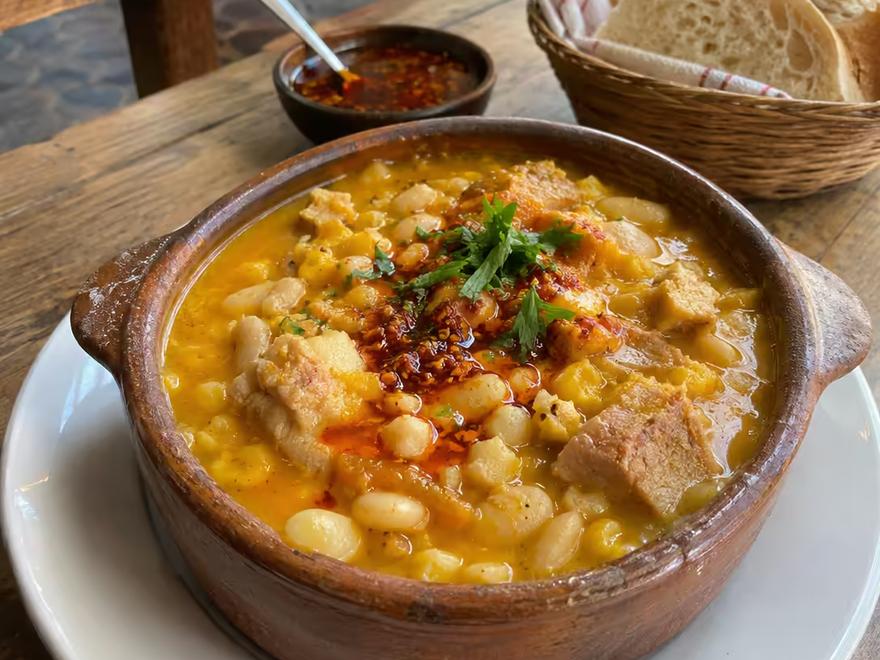
Locro is northwest Argentina's contribution to the national table, a thick corn and bean stew built with pork, cooked low and slow until it turns almost porridge-thick. It is strongly associated with Argentina's national holidays, where it shows up on tables across the country.
The finishing spoonful of red, paprika-stained fat is not decoration, it carries most of the dish's heat and color. A bowl of locro without it is a noticeably different, flatter dish.
Part of our 20 best Argentine recipes list.
method
Drain the soaked corn and beans. Put them in a very large, heavy pot with the pork ribs, pork belly, onion and water.
Bring to a boil, skim the foam, then lower to a gentle simmer. Cook, partly covered, for 2.5 to 3 hours, stirring occasionally and topping up with hot water as needed, until the corn and beans are soft and starting to break down.
Add the chorizo and pumpkin for the last 45 minutes of cooking, so the pumpkin breaks down into the stew and thickens it further.
Continue cooking until the whole pot is thick, almost porridge-like, with the meats falling-apart tender. Season with salt.
For the topping, heat the oil or lard in a small pan, add the paprika, bell pepper and chili, and cook gently for 3 to 4 minutes, until the fat turns a deep red-orange.
Ladle the locro into bowls and spoon a little of the red topping over each one just before serving.
chef's tips
- Locro is traditionally eaten on Argentina's national holidays, May 25 and July 9, and many families still treat it as a holiday-specific dish rather than an everyday one.
- The red topping, sometimes called the "quemado," is not a garnish you can skip. It brings the heat and color the rest of the stew does not have on its own.
- This genuinely needs the full cooking time. Rushed, the corn stays too firm and the stew never develops the thick, almost porridge-like body that defines it.
- Locro freezes extremely well, and most households consider it even better reheated the next day.