
Nuremberg Elisenlebkuchen
Nuremberg's famous Christmas gingerbread, dense with ground nuts and barely any flour, baked on wafers and glazed or chocolate-dipped.
- prep
- 40 min
- cook
- 20 min
- total
- 1 h
- serves
- 20
- level
- medium
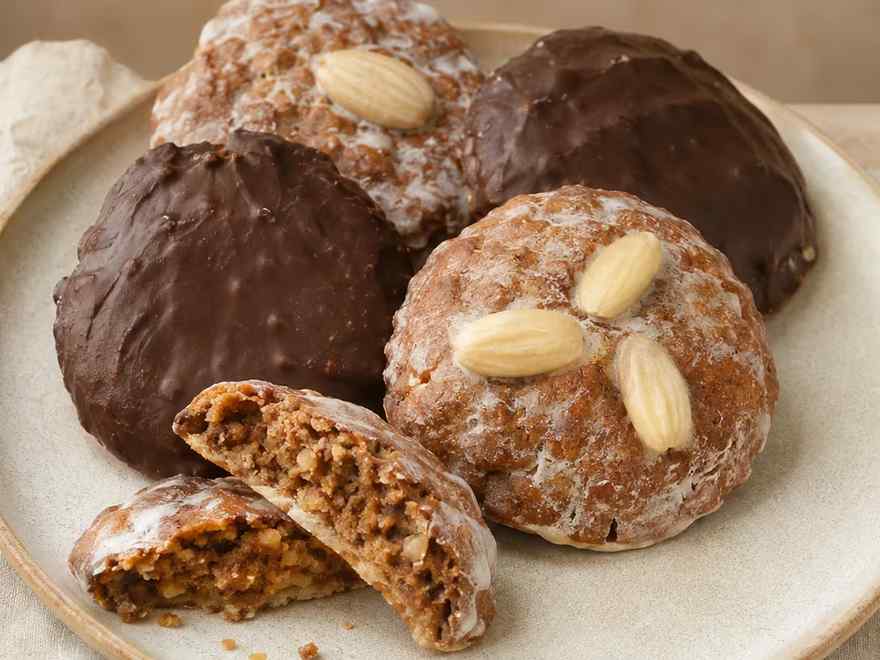
Elisenlebkuchen are Nuremberg's most famous Christmas gingerbread, a protected regional specialty that can only be called Nürnberger Lebkuchen if it's actually baked in Nuremberg, Germany, traditionally baked on a round wafer called an Oblate.
German regulations require this style to be at least 25% nuts with very little flour, which is why the batter here is built from ground hazelnuts and almonds rather than a standard flour-based cookie dough; some of the best Nuremberg bakeries push closer to 40% nuts.
method
In a large bowl, beat the eggs and sugar together until pale and thick, about 3-4 minutes.
Stir in the ground hazelnuts, ground almonds, candied orange and lemon peel, flour, spices, and lemon zest until a thick, sticky batter forms.
Cover and let the batter rest at room temperature for at least 1 hour, overnight if you have time, so the flavors meld.
Preheat the oven to 320°F (160°C). Spoon a generous mound of batter onto each Oblaten wafer, spreading it to the edge with a wet spoon or hands.
Arrange on a baking sheet and bake for 18-22 minutes, until set and lightly golden at the edges; they'll still feel soft in the center.
Let cool completely on the tray.
While still slightly warm, brush half the cookies with the powdered sugar glaze. Dip the other half in melted dark chocolate, letting the excess drip off.
Let the glaze or chocolate set completely before storing.
chef's tips
- The nuts, not the flour, are what hold these together; this is a genuinely low-flour recipe, so don't be tempted to add more or they turn cakey.
- Oblaten wafers keep the bottoms from burning and are the traditional base; they're sold at German grocers and online, and parchment works as a substitute.
- Make ahead: these actually need to be made ahead. Fresh off the tray they're dry; stored in a tin for a few days, they soften into the right chewy texture.
- Storage: keep in an airtight tin at room temperature for 2-3 weeks; they keep getting better for the first week or so.